 Show all articles
How we made our cute logo animation
We gave our logo hands, feet, and a very big yawn. Getting there took a few wrong turns and a much better way to give feedback.
What would Grum's logo do if it got bored sitting in a website header all day? We decided it might get sleepy, stretch its little arms, and let out a yawn.
That idea became a logo animation made with AI. We explored poses in storyboard grids, used Claude to animate the mark as an SVG, and refined individual frames until the movement had some personality.
The useful part of the experiment was learning how to direct it. A reference image or an annotated frame often got us further than another paragraph of instructions.
Watch our logo yawn

Finding motion that felt like Grum
We started with tools that promised quick logo animations. The results could shake, expand, or move the mark around, but they didn't do much with its particular shape. We wanted to see what the Grum logo itself could express.
ChatGPT was useful for exploring that question visually. We asked for a five-by-five storyboard grid: five animation ideas, with five key poses for each. It gave us several directions to react to before committing to one.
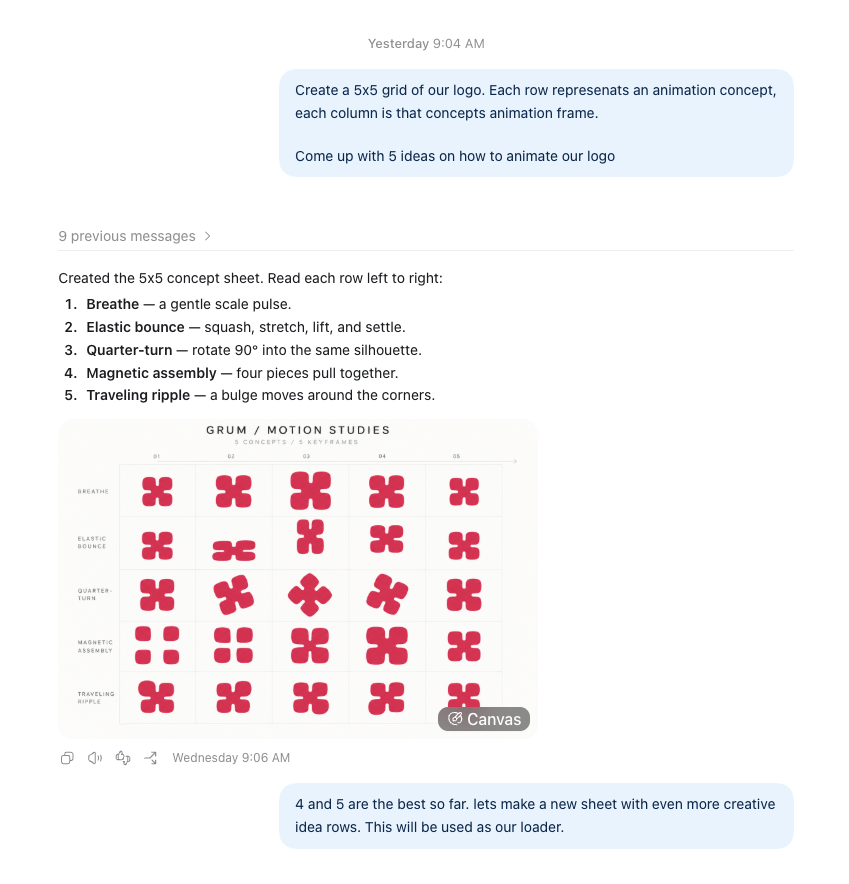
Turning those concepts into motion was harder. The generated animations kept drifting away from the storyboard. We tried several instructions and output formats, including GIF, SVG, and Lottie, without getting the result we wanted.
Trying Claude gave us a more promising starting point. It chose animated SVG on its own, and the first version felt tailored to the logo. There was enough there to keep going.
Giving the logo a little character
During the experiments, we started referring to the top two nodes as hands and the bottom two as feet. That gave us a shared vocabulary for directing a fairly abstract shape.
Then came the sleepy-header idea. We could imagine the logo slouching, nodding off, or yawning after sitting there all day. A yawn gave the animation an action with a beginning, a stretch, and a return to rest.
Thinking about it as a character also made the feedback more specific. We could ask for its hands to reach further, or for a stretch to feel bigger. Those directions were much easier to work with than asking for a logo to be more interesting.
The storyboard became our feedback tool
Our most useful habit was asking for a storyboard with each new animation version. That let us inspect the movement as a sequence and point to the exact moment we wanted to change.
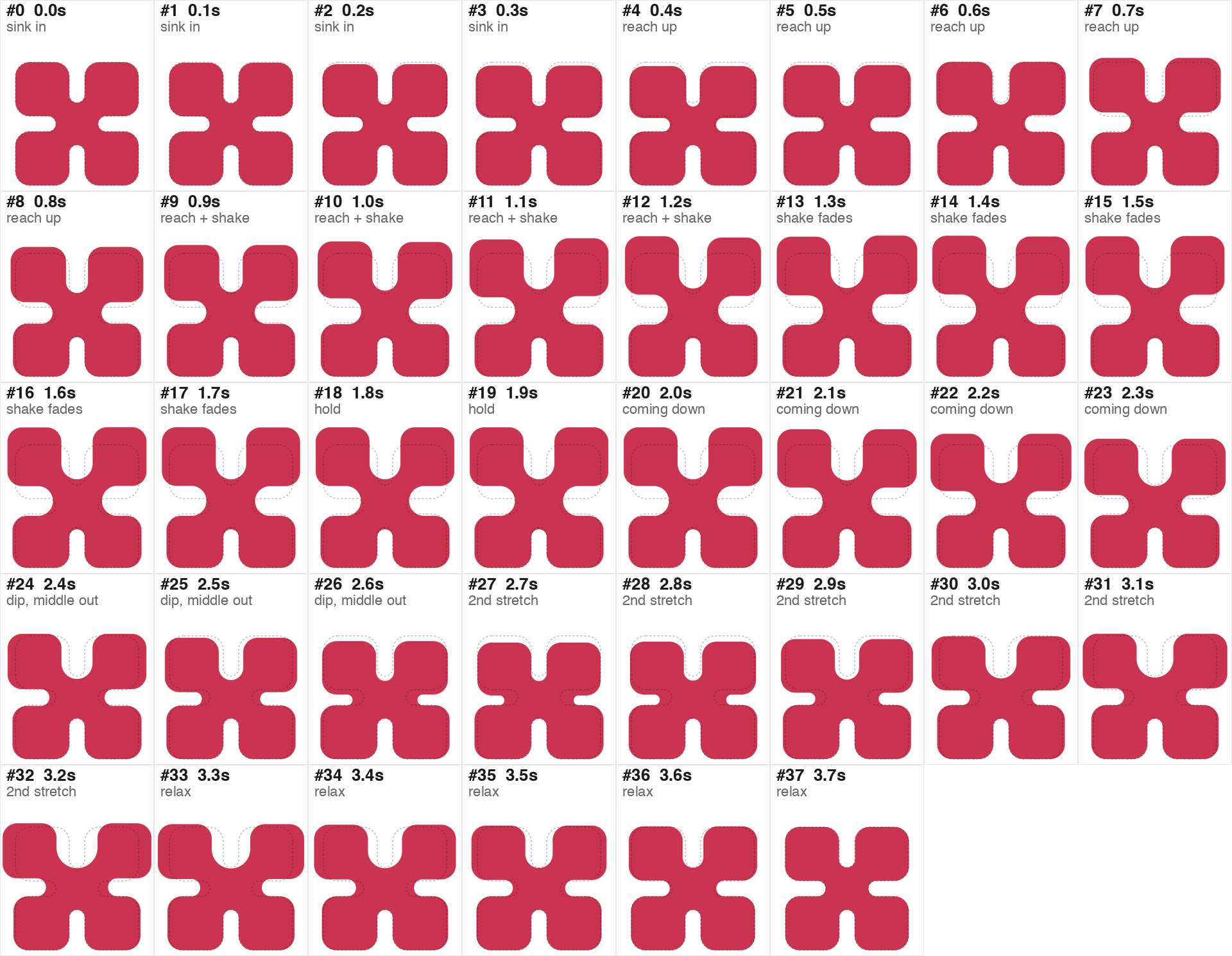
For example, we wanted the hands to extend further and shake during frames 32 and 33. Naming those frames removed a lot of ambiguity. The request had a location in the animation, a part of the character, and a specific change.
It worked for small shape problems too. We spotted a tiny bulge where a node met its stem. Circling that spot on a frame helped the agent fix the contour while preserving the rest of the movement.
We kept moving between the full animation and the frame sheet. Watching the loop told us how it felt. Looking at the frames helped us explain why.
Showing the movement we meant
Another experiment involved jumping jacks. We knew the movement we wanted, but describing the coordination of the arms and legs wasn't getting us there.
A human motion reference made that much easier. It showed the relationship between the poses directly, giving the agent something more useful than another attempt to describe the movement in words.
There was also room for broader direction. Asking it to "give it life" sometimes introduced small movements we hadn't thought to specify. Those surprises were useful once we had a clear character and a way to review the result.
What we'd do again
If we were starting another Grum animation tomorrow, we'd keep the same few habits:
- Start with an action. A sleepy yawn gives the movement a reason and helps us judge whether it feels right.
- Explore with a small storyboard. Compare a few ideas before spending time refining one.
- Name the parts. Hands and feet made it easier to direct an abstract logo.
- Ask for frames with each version. Use frame numbers and annotations to make feedback precise.
- Bring a reference. Show the rhythm or pose when the words aren't getting the idea across.
For this experiment, Claude gave us the strongest animation starting point. The bigger lesson was how much we could contribute through visual references, a sense of movement, and careful feedback. The agent produced the motion; we still had to decide what felt like Grum.
Now our little mark can have a sleepy moment of its own.
Read about Grum's design contract

