 Show all articles
Memory Drift: the review game that is closer to real work than it looks
Five seconds to study a page. Fifteen seconds to find what the agent changed. It is a game, and it is also most design reviews.
We made a small game called Memory Drift. You look at an approved webpage for a few seconds. Then the page changes, because "your agent made some improvements." Your job is to click every spot that drifted before the release ships.
It sounds easy. Most people miss something on their first run. That is the point, and it is also why we think the game is more realistic than it first appears.
How the game works
A run has three rounds. Each round follows the same beat:
- Study the approved page. You get five seconds with a small storefront, event page, or product page. This is the version everyone signed off on.
- The agent makes its changes. The page swaps to a new version with 3, then 4, then 5 changes, depending on the round.
- Catch the drift. You have fifteen seconds to click every area you think changed. Correct finds repair the page on the spot.
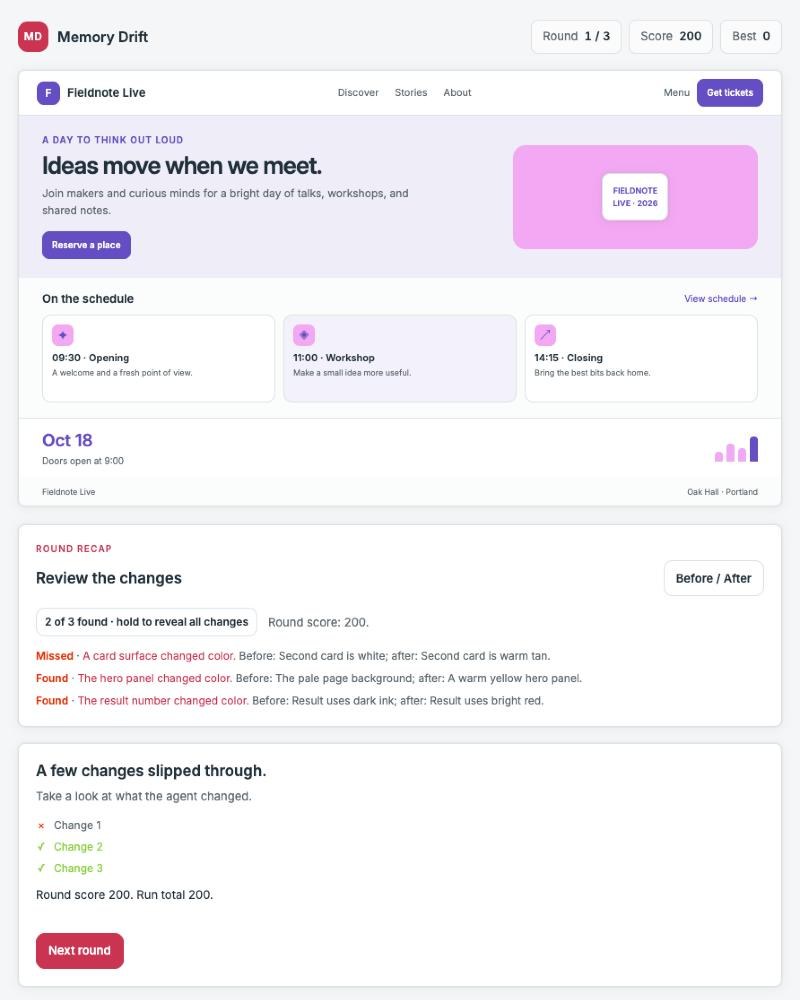
- Review the recap. After the round you can compare before and after and see what you missed.
The changes are the kind we see every week in real code. A headline gets a little heavier. A card loses its rounded corners. The space between cards shrinks. The main button disappears, or a second one shows up next to it. The footer text slides to the center. None of them break the page. All of them make it different from what was agreed.
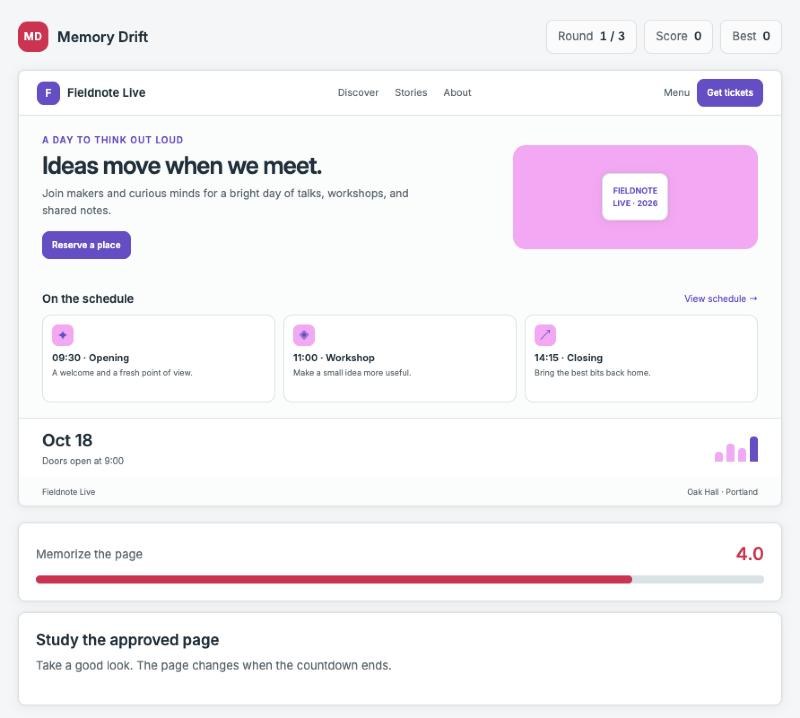
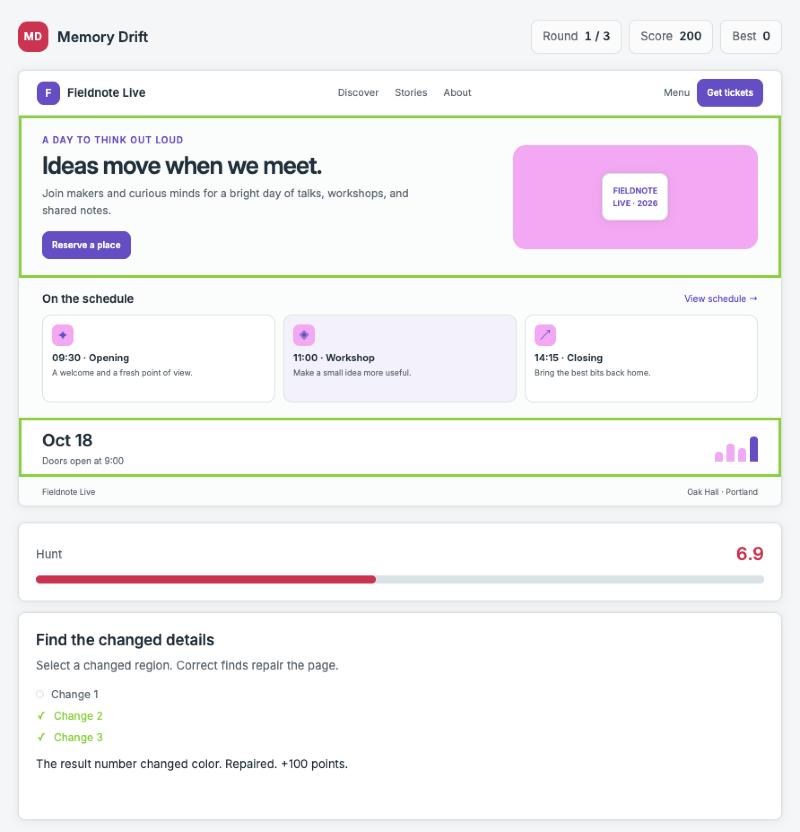
Every run uses a seed, so you can copy a challenge link and send the same rounds to a teammate to see who catches more.
Why it is more realistic than it looks
Five seconds feels unfair. But think about how a typical review actually happens. A pull request lands with a screenshot or a preview link. You remember roughly what the page looked like last week. You scroll, it looks fine, you approve. That is a memory test with a time limit, just like the game.
Your memory of "approved" is fuzzy
Nobody keeps a pixel-perfect picture of every screen in their head. Research on working memory suggests people hold only a handful of items at once, roughly three to five chunks. The game asks you to track 3, 4, then 5 changes on purpose. By the last round you are past what most people can comfortably hold.
Small changes hide in plain sight
Psychologists call this change blindness. In a well-known study, people repeatedly looked at two versions of a photo and often took a long time to spot even large differences between them. In another, many people did not notice that the stranger they were talking to had been swapped for a different person. If that can be missed, a 4px radius change on a card can certainly slip by.
Here is a real first round. The hero and the date were easy. The schedule card was not, even though it sits right in the middle of the page.
The page still works, so nothing feels wrong
Drift rarely looks broken. A new button color still looks like a button. Tighter spacing still reads fine. Your brain checks "does this look reasonable?" when the real question is "is this what we agreed?" Those are very different checks, and only the first one is fast.
The stress of "did I miss anything?"
The hardest part of the game is not the clicking. It is the last few seconds, when you have found three things and are not sure if there is a fourth. That feeling is the same one designers and engineers carry at the end of a busy day.
- The work is done, but the check is not. The feature is built and the demo is tomorrow. Reviewing every screen against the approved design is the step that gets squeezed.
- Volume keeps going up. With coding agents, a single afternoon can produce more UI changes than a week used to. The number of things to compare grows faster than the time to compare them.
- Misses show up later, and in public. A drifted button is easy to fix the day it is made. Found by a customer, or copied into five more screens, it costs much more.
- Nobody is sure who should catch it. The designer assumes the engineer matched the spec. The engineer assumes the agent did. The agent assumes the code it was given was the standard.
So the review turns into a quiet worry instead of a clear step. You ship, and a small part of you wonders what slipped through.
Agents have a clock too
It is tempting to think a coding agent never gets rushed. In practice it works under its own limits. It has a fixed amount of context, so the approved design may have scrolled out of view by the time it edits the fifth file. It is often asked to finish in one pass. And it is usually trying to make the page look good, which is not the same as making it match.
That is where the "improvements" in the game come from. A heavier headline or a second call to action can be a sensible guess. Without a clear record of what was approved, the agent has nothing to compare its guess against, and neither do you.
Taking memory out of the review
The game is fun because it relies on memory and a timer. Real reviews should not. That is the idea behind a design contract: write the approved tokens, buttons, and inputs down in a form both people and agents can read, then check new code against it.
With Grum, the agent reads the contract before it changes the UI and checks its own work for drift before it finishes. When something departs from the agreement, it shows up as a named item with a fix or a review request, not as a hunch in the last five seconds of your day.
A source check does not replace looking at the page. You still need visual review and product judgment. But it means your eyes can go to the questions that need a person, instead of trying to remember whether that card always had square corners.
Try a few rounds and see how much you catch. Then send the challenge link to someone on your team.
Play Memory Drift

